

Right vs Kind: Why Good Kids (and Adults) Still Become Bullies
I recently watched a Talking Point episode digging into why bullying seems to be rising among children under 12 in Singapore. It was triggered by a viral clip — a nine-year-old making violent threats — and the episode spent a good deal of time asking the harder question: why do young children lash out, and do they even understand the weight of what they’re saying?
One moment stuck with me. The host, Diana Ser, turned the question back on the mothers in the room and asked them plainly — do you ever worry that your child could be the bully?
That’s a question most of us don’t ask ourselves. We worry about our children being bullied. We rarely stop to ask if we’re raising the child doing the bullying.
I wrote about this before, after watching my eldest daughter — nine at the time — use her size and her sharper reasoning to overpower her six-year-old siblings. She wasn’t being cruel on purpose. In her mind, she was just asserting what she believed was fairly hers. But the effect on her siblings was the same as if she had meant it. That’s what pushed me to think harder about how we teach children to apply values, not just hold them.
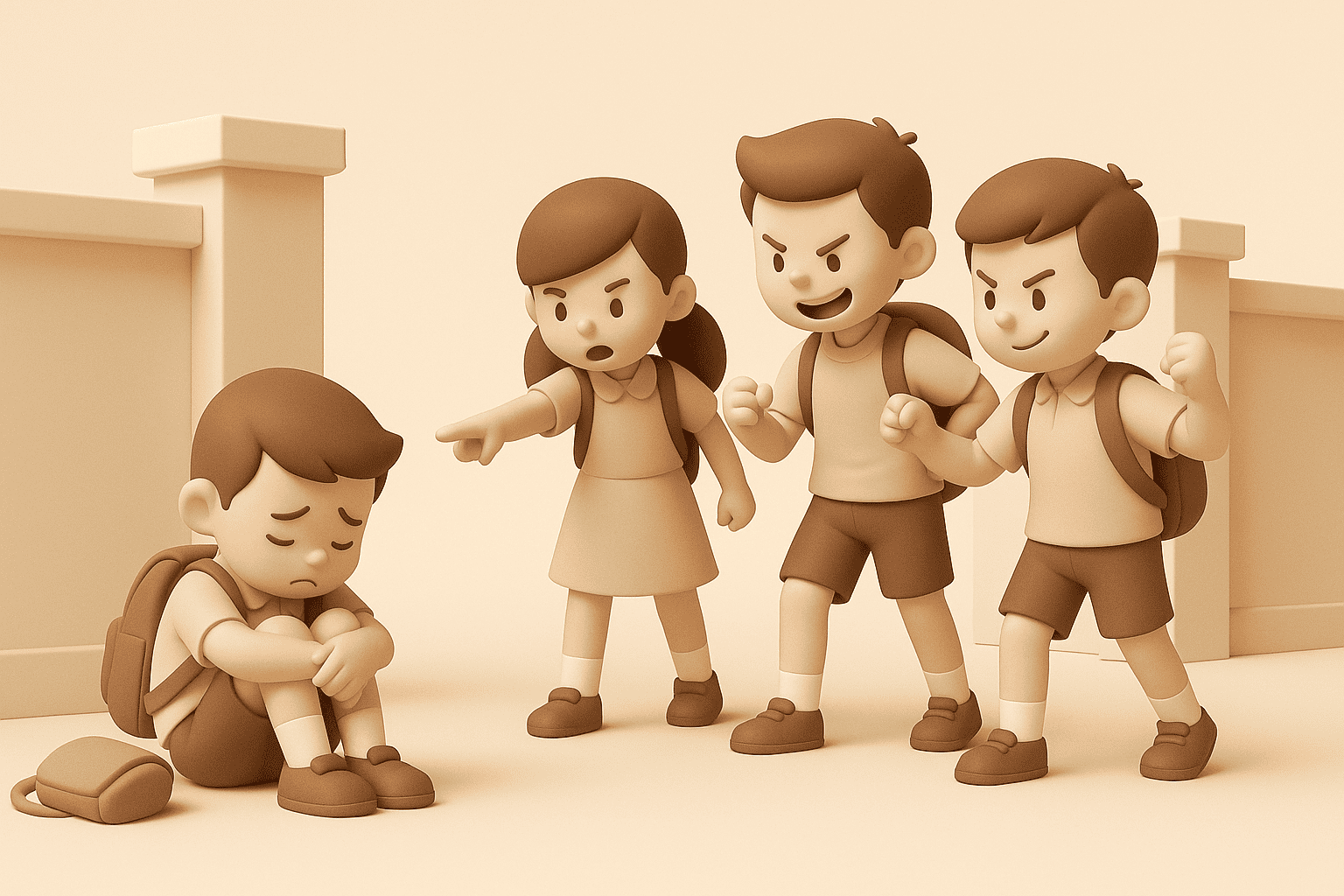
This episode added a layer I hadn’t fully considered: the emotional and neurological side of the story.
What the Science Adds
The experts featured made a fair point — a lot of what looks like bullying isn’t calculated cruelty. It’s a child who hasn’t yet developed the capacity to regulate big emotions, acting out because they simply don’t have another way to release the pressure.
Two things stood out to me:
- Brain synchrony. Neuroimaging research cited in the episode showed that a parent’s calm, attentive presence can act almost like an external regulator for a child’s nervous system. When we’re genuinely present — not half-listening with a phone in hand — we help our children’s brains find their footing.
- Overstimulation. Heavy screen time, especially content designed for older audiences, can overload a young brain’s ability to manage frustration and anger. That tracks with what most parents already sense but rarely name.
Both points are useful. Presence matters. Screen time matters. I don’t disagree with either.
But Here’s My Caution
Where I paused was the claim that more children today can’t regulate their emotions, with screen time named as the likely cause.
Here’s the thing — I don’t fully trust that claim, and I think there’s a bias worth naming.
When my wife was pregnant, I suddenly started noticing pregnant women everywhere. Malls, the MRT, the coffee shop downstairs. Nothing had changed in the world — there weren’t suddenly more pregnant women in Singapore. What changed was my attention. My brain had a new category to filter for, so it started surfacing every match it had previously ignored.
This is called the frequency illusion (sometimes called the Baader-Meinhof phenomenon), and it usually travels with a close cousin, confirmation bias — once you’re primed to notice something, you register every hit and quietly ignore the misses, which makes the pattern feel stronger than it is.
I think something similar is happening with bullying. It’s getting more airtime — viral clips, TV segments, school programmes — so we’re noticing it more, talking about it more, and studying it more. That doesn’t necessarily mean there are more incidents than before. It may just mean we finally have the language and attention to see what was always there. There’s likely some recency bias at play too — we tend to weigh what just happened, or what’s fresh in the news cycle, more heavily than the quieter reality of the past.
I’m not saying screen time is blameless. Controlling it is still worthwhile. But I’d be cautious about experts confidently declaring things are getting worse, when what’s actually improved is our awareness. Those are two very different claims, and mixing them up leads to the wrong kind of panic — and sometimes the wrong solutions.
It’s Not Emotion Alone. It’s Values Too.
What I appreciate about the episode is that it gives us real science to work with. But I still think we need to manage this from two angles at once: the emotional regulation side, and the values side I wrote about previously — where children (and honestly, adults) act on good instincts like fairness or justice, but apply them in ways that hurt someone.
This isn’t only a kids’ problem. As chairperson of my MCST council, I’ve watched fully grown adults fall into the exact same trap. Someone is technically right about a by-law — say, a resident parking in the wrong lot — and instead of a quiet word, it becomes a public callout in the residents’ group chat, tagged, screenshot, shared. The rule was on their side. The kindness wasn’t. And the outcome looks a lot like adult bullying, dressed up as being right.
That’s when I realised — we don’t actually give children (or ourselves) a simple way to check both things at once: is this right, according to the rules, and is this kind, to the person in front of me?
A Simple Framework: Right vs Kind
| Kind to others | Unkind to others | |
|---|---|---|
| Follows the rules | The Right Way — correcting something quietly, helping a friend without breaking rules | Righteous but Cruel — technically correct, but used as a weapon: public shaming, “gotcha” callouts, ganging up |
| Breaks the rules | Wrong but Warm — bending a rule to help someone, like giving a friend lunch money without permission | Wrong and Harmful — breaks rules and hurts someone — classic bullying |
Here’s a four-quadrant way to think about it, which I’ve started using with my own kids:
The quadrant that worries me most isn’t the obvious “wrong and harmful” one — children already sense that’s bad. It’s Righteous but Cruel. That’s the blind spot, because it feels justified from the inside. My daughter wasn’t thinking “I’m being unkind.” She was thinking “I’m right.” That’s exactly why it slipped past without her noticing — and why it slips past adults in a residents’ chat group too.
The goal isn’t to pick a favourite quadrant. It’s to teach children — and remind ourselves — to check both boxes before acting, not just the one that feels comfortable. Being right doesn’t excuse being unkind. Being kind doesn’t excuse breaking rules that exist to protect people.
Bringing It Home
I don’t think this replaces what the Talking Point episode raised — presence, regulation, mindful screen use are all still worth doing. But I’d add the values check as a second, equally important layer.
A simple dinner-table question can do a lot of work: “Were you right? And were you kind? Because you can be one without the other, and that still counts.”
If we can get our kids comfortable asking themselves both questions — not just “am I right” — we’ve given them a tool that will serve them far beyond the school playground. It’ll serve them in the office, in the family group chat, and yes, even at the next MCST meeting.