
When You’ve Tried Everything… and Still Failed 😅
I’ve been trying to lose weight for years.
Dieting. Exercising. Restarting. Quitting. Restarting again.
If there were loyalty points for “new fitness routines”, I’d probably have redeemed a free treadmill by now.
And no, this isn’t one of those triumphant “I finally succeeded” stories. I haven’t.
But something interesting happened along the way.
Even when the weighing scale refused to cooperate, I started noticing patterns. Patterns that didn’t make sense… until I read Burn by Herman Pontzer.
That was my “A-ha” moment.
The Frustrating Truth: Exercise Barely Moved the Scale
Here’s the uncomfortable bit many of us quietly experience:
- I exercised more
- I ate “healthier” (or so I thought)
- The weight barely budged
At first, I assumed I lacked discipline.
But Pontzer’s research explains something many of us live through:
Exercise doesn’t help much with weight loss. Reducing food intake does.
That sentence alone felt strangely comforting.
Not because it excuses bad habits, but because it finally validated reality.
Your body adapts. It compensates. Burn more energy exercising, and it quietly spends less elsewhere. The total calories burned per day barely changes.
So no, I wasn’t imagining things. I wasn’t broken.
So Why Exercise Still Matters (More Than I Ever Realised)
Here’s the plot twist.
Even though exercise didn’t help me lose much weight, it changed everything else.
I Became Calmer and Happier
Whenever I exercised regularly, something shifted.
- I was less irritable
- My stress levels dropped
- I slept better
- My mind felt… quieter
The scale stayed stubborn, but my mood didn’t.
Exercise didn’t shrink my waistline much, but it expanded my emotional bandwidth.
And honestly, that alone is priceless.
The Body Ache Mystery (and the Expensive Detour)
For years, my body ached.
Lower back. Shoulders. Neck. Hips.
I blamed age. Work. Stress. Bad posture.
I spent money on:
- Massages
- Chinese tui na
- Temporary relief
And yes, they worked… briefly.
Then the aches came back. Again. And again.
Until something clicked.
Strength Training Changed Everything 💪
When I finally committed to strength training, something unexpected happened.
The aches disappeared.
Not overnight. But steadily.
That’s when I realised the uncomfortable truth:
My body wasn’t “old” or “inflamed”. It was weak.
Weak muscles were struggling to support:
- My body weight
- Daily movement
- Sitting, standing, walking
Once I strengthened them, my body stopped protesting.
Pain wasn’t a mystery anymore. It was a message.
What I’ve Learned (And Why I’m Sharing This)
Here’s my distilled takeaway:
- Diet controls weight
- Exercise controls health
- Strength controls pain
- Movement controls mood
If you’re exercising and frustrated that the scale won’t move, you’re not failing.
If you’re dealing with constant body aches or inflammation, the answer may not be another massage.
It might be simple, boring, consistent exercise.
Nothing dramatic. Nothing extreme.
Just enough to remind your body that it was built to move and carry itself.
What Else I’ve Learnt from Burn (That Completely Changed How I See Health)
Beyond validating my own frustrating experiences, Burn helped me understand why my body behaved the way it did.
Here are a few ideas from the book that really stuck with me.
1. Hunter-Gatherers Don’t Burn More Calories Than Us
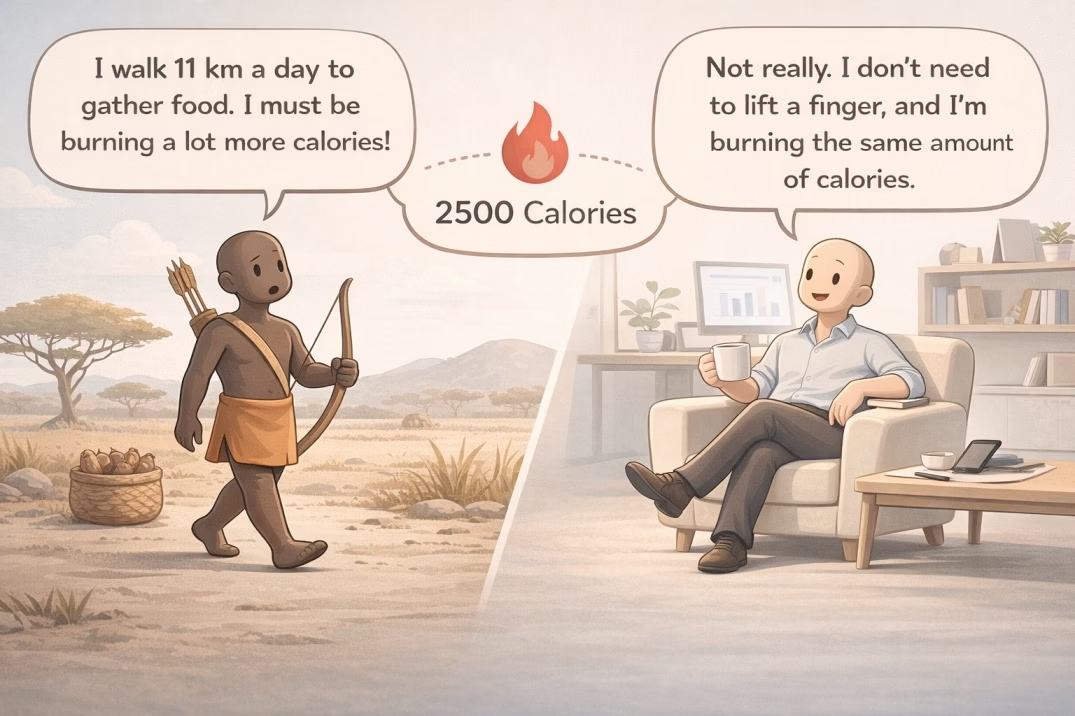
One of the most mind-bending studies in the book involved the Hadza, a hunter-gatherer community in Tanzania.
These are people who:
- Walk many kilometres a day
- Hunt, dig, climb, and gather food daily
- Live a lifestyle most of us would call “extremely active”
Yet when researchers measured their total daily calorie expenditure, it was…
almost the same as a typical adult in a modern city.
Let that sink in.
Despite all that movement, their bodies didn’t burn dramatically more calories than ours.
This single study flipped my thinking upside down.
It explains why:
- Modern people don’t automatically lose weight just by exercising more
- Our ancestors weren’t lean because they burned more calories
- The obesity problem isn’t caused by “not moving enough” alone
Our bodies are far smarter and more adaptive than we assume.
2. Your Body Runs on an Energy Budget (Not a Bonus System)
I used to think of exercise like a credit card:
Move more → burn more → lose weight
Pontzer shows that the body doesn’t work that way.
Instead, it behaves more like a monthly budget.
If you:
- Spend more energy exercising
- Your body quietly saves energy elsewhere
Less energy for:
- Inflammation
- Stress responses
- Certain hormonal activities
- Even unconscious movement
So total calories burned per day stay within a narrow range.
This explains why I could exercise consistently and still feel:
- Hungrier
- More tired
- Not significantly lighter
My body was just rebalancing the books.
3. Exercise Is Not for Weight Loss. It’s for Health.
This was the line that finally made everything click:
Diet is for weight loss. Exercise is for health.
Exercise:
- Improves mood
- Reduces inflammation
- Strengthens muscles and joints
- Improves sleep and mental clarity
- Makes daily life feel easier
That matches my experience perfectly.
The scale barely moved.
But my:
- Body aches reduced
- Stress dropped
- Emotional resilience improved
Exercise wasn’t failing me.
I was just expecting the wrong outcome from it.
4. Pain Isn’t Always Damage. Sometimes It’s Weakness.
This was never stated outright in the book, but it connected the dots for me.
Modern life:
- Sitting a lot
- Moving less
- Using fewer muscles
When muscles weaken:
- Joints take more load
- Posture collapses
- Small movements become stressful
No amount of massage fixes that long-term.
Strength does.
Once I started strengthening my body, it finally made sense why:
- Temporary relief never lasted
- Exercise, not treatment, removed the pain
Why This Changed How I Treat My Body
After reading Burn, I stopped:
- Punishing myself for not losing weight fast
- Using exercise as a weight-loss weapon
- Treating pain as something to “fix” externally
Instead, I focus on:
- Eating less, calmly and consistently
- Exercising for strength, mood, and resilience
- Treating movement as maintenance, not punishment
I’m still a work in progress.
But at least now, the rules of the game make sense.
And that alone makes the journey far less frustrating.
A Gentle Nudge for Anyone Struggling
If you’re:
- Battling stubborn weight
- Living with constant aches
- Feeling inflamed or low-energy
Maybe start here:
- Eat a little less
- Move a little more
- Lift something slightly heavier than yesterday
Not to lose weight fast.
But to feel better living in your own body.
That alone can change your quality of life.
Sources & Further Reading
The ideas shared in this post are based on the work of Herman Pontzer, whose research has reshaped how scientists understand metabolism, exercise, and energy expenditure.
📘 Book
- Burn: The Misunderstood Science of Metabolism
Herman Pontzer (2021)
https://www.penguinrandomhouse.com/books/653293/burn-by-herman-pontzer/
🔬 Key Scientific Studies
- Pontzer et al. (2012) – Hunter-Gatherer Energetics and Human Obesity
PLOS ONE
https://journals.plos.org/plosone/article?id=10.1371/journal.pone.0040503 - Pontzer et al. (2016) – Constrained Total Energy Expenditure and Metabolic Adaptation
Current Biology
https://www.cell.com/current-biology/fulltext/S0960-9822(15)01577-8 - Pontzer et al. (2021) – Daily Energy Expenditure Through the Human Life Course
Science
https://www.science.org/doi/10.1126/science.abe5017
🧠 Accessible Explanations (Non-Technical)
- Scientific American – The Exercise Paradox
https://www.scientificamerican.com/article/the-exercise-paradox/ - Duke University Research Blog – Why Exercise Doesn’t Burn As Many Calories As You Think
https://today.duke.edu/2016/04/exerciseparadox
✍️ How These Sources Informed This Post
These studies show that:
- Hunter-gatherers such as the Hadza burn similar daily calories to sedentary adults
- The human body operates within a constrained energy budget
- Exercise improves health, mood, inflammation, and physical resilience, but contributes only modestly to weight loss
- Diet plays a far larger role in long-term weight management