
Introduction: A Marketer’s Journey into Behavioural Science
I first picked up Thinking, Fast and Slow back in 2016 as an eBook. At the time, I was completely fascinated by the promise of the title — but I’ll be honest, it took me a long time to digest. Daniel Kahneman’s writing is deep and layered, and I often had to reread entire chapters to really grasp what he meant. But once it clicked, I was hooked. That book opened a whole new way of seeing how people think and make decisions — and eventually how we, as marketers, can connect better with them.
I got so into behavioural science that I ended up volunteering to share what I learned at my workplace, Sabre. I prepared a talk that broke down the book’s core ideas, with lots of interactive games and audience questions to keep it engaging. I was worried it might come across too technical or “geeky”, but to my surprise, many in the room loved it.

That experience taught me something important: there are many ways to digest this kind of material — and often, the best way is to explain it in layman’s terms with practical examples. That’s precisely what I try to do in this blog: connect those “a-ha” behavioural science moments with everyday digital marketing — particularly in ad copy and email writing — so that even beginners can benefit from the psychology behind persuasion.
System 1 vs. System 2: The Two Ways We Think
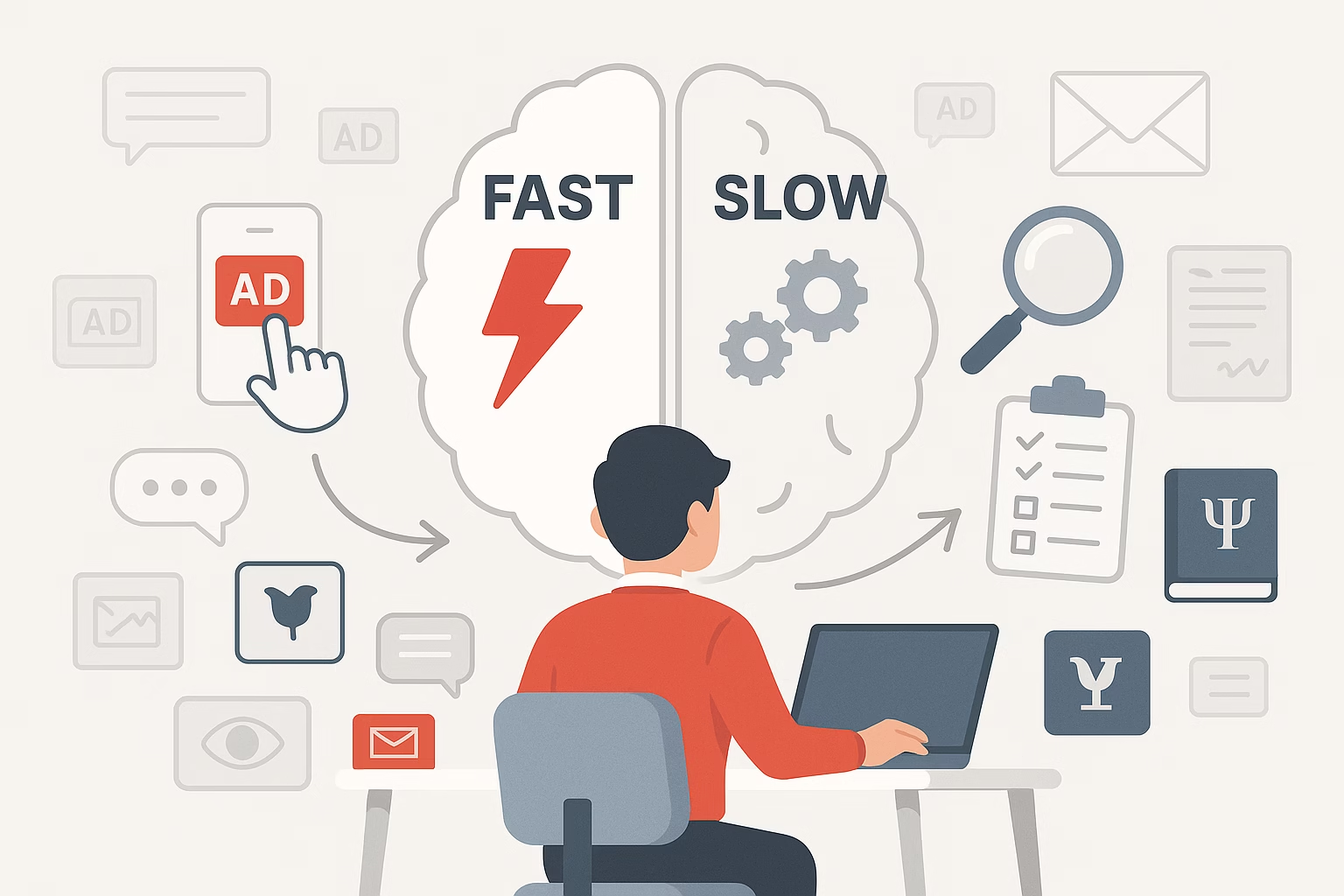
Imagine you have two brains in your head. One is fast and impulsive – it makes snap judgments without you even realising. The other is slow and careful – it weighs options and reasons things out. Daniel Kahneman calls these System 1 and System 2
- System 1 is your fast, automatic thinking. It’s emotional and instinctive. This is the mind that decides in a split second. For example, if you see a catchy Facebook ad and impulsively click “Buy Now” because it feels right, that’s System 1 in action. According to Kahneman, System 1 is fast, instinctive and emotional. In fact, most of our everyday decisions are driven by System 1 – they happen quickly with little effort (smartinsights.com).
- System 2 is your slow, deliberate thinking. It’s logical and effortful. This is the mind you use when you analyse or double-check. For instance, when comparing software pricing or proofreading an email to your boss, you’re engaging System 2. Kahneman describes System 2 as slower, more deliberative and logical – the thinking that kicks in when we stop to really consider a problem. System 2 decisions take more time and effort. We don’t use System 2 for every little choice (that would be exhausting!), but it steps in for big decisions or complex tasks.
Why does this matter for marketing? As a marketer, understanding these two thinking modes is gold. Most customers operate in System 1 for most of their day-to-day choices (smartinsights.com), making quick, gut-feel decisions. That Facebook ad scroll, that skim of an email subject line – these are usually System 1 moments. So your ad copy and emails need to first appeal to the fast, intuitive brain. Use clear, simple messaging and emotional triggers to grab attention (more on those soon). Then you can provide supporting info for the slower System 2 (for the few who read the fine print or click to your landing page). In essence, great marketing hooks System 1, then satisfies System 2.
Heuristics: Mental Shortcuts Your Customers Use
After understanding our two thinking systems, the next step is to learn about heuristics. (Don’t let the term scare you – heuristics means mental shortcuts or rules of thumb.) Our brains are pretty lazy in a clever way. We like to save mental effort by using simple shortcuts to make decisions quickly (verywellmind.com). Instead of analysing every detail, we often rely on past patterns or quick judgment cues.
For example, have you ever chosen a restaurant because it was busy with locals? You didn’t consciously analyse the menu in depth; you just assumed it was good because others seemed to like it. That’s a heuristic at work (in this case, a form of social proof, which we’ll cover soon). Heuristics allow people to solve problems and make judgments quickly and efficiently (verywellmind.com) – they’re the brain’s way of cutting corners (usually for better, sometimes for worse).
Common heuristics include things like the availability heuristic – we judge how likely something is by how easily we can think of an example. Suppose you easily recall a story of someone who gained many clients via LinkedIn. In that case, you might overestimate how effective LinkedIn is overall (because one vivid example “came to mind” easily, so it feels important). Another is the affect heuristic—basically, going with your gut feeling. If thinking about a product gives you a warm, fuzzy feeling, you’ll assume it’s a good choice without much further thought.
How Marketers Can Leverage Heuristics
Understanding heuristics helps you craft marketing that fits the brain’s shortcuts instead of fighting them. Here are a few ways to apply this insight:
- Keep it Simple and Familiar: A confused mind says no. Use familiar words and references in your copy so readers’ System 1 instantly “gets it.” If your audience instantly recognises what you’re talking about, they’re more likely to trust it. (This taps into what Kahneman calls processing fluency – if something is easy to process, it feels truer or more appealing.)
- Use the Availability Heuristic: Make your product or offer memorable. In an email, share a quick, relatable success story or testimonial. For instance, “<em>Jane, a local boutique owner, doubled her sales in one month using our marketing tool</em>.” A vivid example like this sticks in the reader’s mind. Later, when they think about improving sales, that story comes to mind and makes your solution feel effective (because if they can easily recall it, it must be important, right?).
- Harness the Affect Heuristic: Evoke positive emotion around your brand. In ad copy, use imagery or words that carry good vibes – excitement, ease, happiness. For example, an email subject like “You’re going to ❤️ this easy SEO trick” uses a heart emoji and the promise of an easy win to create a quick positive feeling. If reading your copy feels good, users’ fast-thinking minds will assume the product is good too, thanks to this emotional shortcut.
The takeaway is to align your marketing with the brain’s natural shortcuts. Give readers quick cues that say “this is good!” without making them work too hard to figure out why. Next, we’ll dive into specific cognitive biases that often stem from these shortcuts – and how to turn them into marketing advantages.
Cognitive Biases: Turning Human Quirks into Marketing Advantages
Cognitive biases are those systematic patterns of deviation from rational judgment – in plain English, ways our brains trick us into seeing things that aren’t purely logical. We all have these biases (even you and me – nobody is perfectly rational!). The good news for marketers is that by understanding these biases, you can craft messages that resonate better with your audience’s natural tendencies. Below, we’ll look at a few of the big ones – anchoring, loss aversion, and social proof – and how they can supercharge your ad copy and emails.
Anchoring: First Impressions That Stick
Have you ever seen an online store show a “Regular price: $100” next to a “Sale price: $59”? That’s using the anchoring effect. Anchoring is our tendency to rely heavily on the first piece of information (the “anchor”) when making decisions (cognitigence.com). Once our mind latches onto an initial number or idea, it uses that as a reference point for all further judgments (cognitigence.com). In Kahneman’s research, even irrelevant numbers can sway people’s estimates – we’re often not aware of how much that first bit of info guides us.
In marketing, anchoring is a powerful tool. You can influence the perception of value by presenting an anchor first. The classic example is pricing: show the higher original price or a higher-priced comparison first. A study on consumer behaviour notes that displaying a higher “original” price next to a sale price makes the sale price feel like a bargain – the high number sets an expectation, so the lower number seems super attractive in comparison (cognitigence.com). For example, if your email says “Our consulting package is usually $1,000, but for subscribers it’s $500,” that $1,000 is an anchor that makes $500 appear very reasonable (even if $500 is still a lot in absolute terms).
Anchoring in ad copy and emails – quick tips:
- Always establish a favourable anchor. If you’re advertising a discount, lead with the original price or an industry average cost (“Typically $X”). The first figure the audience sees will frame their mindset (cognitigence.com). For instance, “Most marketing courses cost $2000… but this one is $499.” Boom – $499 now looks like a steal.
- You can also anchor with time or quantity: e.g., “Join 50,000+ subscribers” anchors the reader’s sense of scale (50k is a big crowd, implying your newsletter is popular and worthwhile), or “Only 3 spots left” anchors scarcity (more on that in loss aversion below).
One word of caution: ensure your anchor is credible. If you set an unrealistically high anchor (“Normally $10,000, now $10!”), People’s System 2 might wake up and get sceptical. The goal is to nudge perceptions, not to deceive.
Loss Aversion: The Fear of Missing Out (FOMO)
One of the most potent insights from Thinking, Fast and Slow is that people hate losing more than they love gaining. In psychology terms, this is loss aversion – the idea that a loss feels about twice as painful as an equivalent gain feels good (insidebe.com). In other words, losing $10 hurts more than finding $10 makes you happy. We are, by nature, loss-averse: we’ll do more to avoid a loss than to get a similar gain.
In marketing, tapping into loss aversion can be incredibly effective. Often, this shows up as that little twinge of anxiety known as FOMO – Fear of Missing Out. If you’ve ever seen an email about a “24-hour flash sale – don’t miss out!” and felt compelled to act, that’s loss aversion in action. You’re driven more by not wanting to miss the deal (a potential loss) than by the rational evaluation of the gain.
Marketers use loss aversion all the time – and you should too (ethically, of course!). Here are practical ways to apply it in your copy:
- Frame offers in terms of avoiding loss. Whenever possible, highlight what the reader stands to lose if they don’t act, not just what they gain. For example, instead of saying “Gain 100+ new subscribers with our tool,”you might say “Stop losing out on 100+ subscribers – use our tool.” The latter phrasing triggers that loss-averse mindset – nobody likes to think they’re losing opportunities that others are taking. Research suggests messages framed as a potential loss can be more persuasive because losses loom larger than gains (insidebe.com).
- Use scarcity and urgency tactics. These play directly into loss aversion. When an e-commerce site shows “Only 2 items left in stock!” or an event promo says “Early bird pricing ends at midnight,” it’s creating a sense that not acting = losing your chance. Limited-time offers and quantity limits create a psychological pressure – people don’t want to feel the regret of missing out. As behavioural experts note, tactics like “only 2 seats left at this price” or “last chance to save $50” are powerful because they flip that mental switch: act now or lose out (insidebe.com). In your emails, you might include a countdown timer or simply phrases like “Ends tomorrow” or “Last chance” in the subject line or header.
- Leverage the endowment effect: This bias (related to loss aversion) says people value something more once they feel it’s theirs (insidebe.com). How to use it? Try phrasing that makes the reader feel ownership of the benefit. E.g., “Claim your free trial” or “Don’t lose your spot in our VIP list.” The word “your” subtly implies it already belongs to them. If they fail to act, they’re giving up something that was practically in hand.
Remember, the goal isn’t to scare or trick people – it’s to nudge them past indecision. Often, a person really will benefit from your product, but their natural inertia holds them back. A pinch of FOMO or a gentle reminder of what they could miss can motivate them to take that beneficial action. As one marketing expert put it, successful campaigns aren’t just about what people will gain, but about understanding what they fear losing by choosing your product or service (or by not choosing it) (insidebe.com). Use that insight to speak to your audience’s true motivators.
Social Proof: Harnessing the Herd Mentality
Humans are social creatures. When we’re unsure about something, one of the easiest mental shortcuts is to look at what others are doing. If lots of people are buying a product or praising a service, our brain says, “It’s probably good.” This is the essence of social proof – a term coined by psychologist Robert Cialdini to describe how people copy the actions of others as a way to make decisions (nudgify.com). In behavioural science, social proof is sometimes called an informational social influence or simply a herd instinct.
Put simply, social proof is a psychological effect that leads us to follow the crowd (nudgify.com). Especially in uncertain situations, seeing others’ choices helps us feel safer in our own choice (nudgify.com). We figure, “if many others trust this, I can trust it too.” And yes, this often happens via our fast System 1 thinking – “Copying others feels like a quick, safe way to decide” (nudgify.com).
For digital marketers, social proof is a must-use tactic. It’s one of the most direct ways to build trust and credibilitywith a beginner audience. Here’s how you can weave social proof into ads and emails:
- Show Numbers: If you have an impressive number, flaunt it. “Join 5,000+ happy customers” or “Over 1 million downloads” immediately tells a prospect that lots of people trust you. That sheer volume is persuasive: it creates a sense of group consensus that your product is worthwhile (nudgify.com). People think, consciously or not, “If thousands have signed up, it must be good.” (Tip: Be specific and truthful with your numbers – specific figures like “4,732 marketers” can sometimes be even more credible than a rounded “5,000+”.)
- Testimonials and Reviews: Include a short testimonial quote in your email or a blurb in your ad copy. Real words from real users act as social proof that triggers the “people like me tried this and it worked” response. Even a one-liner like “‘Our sales jumped 30% after using [Product]!’ – Alex, Boutique Owner” can do wonders. In uncertain environments like online shopping, factors such as star ratings and customer reviews heavily influence decisions – even a one-star increase in rating can significantly boost sales in some studies (nudgify.com). That’s the power of social proof.
- Logos and “As Seen In”: If you’re running a B2B campaign or selling a service, consider adding “trusted by [big customer]” or media logos (“As featured in BBC, The Guardian…”) in your content. This signals to the reader’s brain that reputable sources or peers endorse you. It’s another form of social validation that can tip a wavering prospect over the edge.
- User-Generated Content: On social media, sharing user-generated content (like a customer’s tweet about your product, or an Instagram photo of them using it) is double win: it’s engaging content and strong social proof. It shows real people out there enjoy what you offer.
When using social proof, make sure it’s relevant to your target audience. People are most swayed by those they can relate to. So if you’re targeting beginner marketers, a testimonial from “Jane, a freelance marketer” might hit harder than one from “Fortune 500 CMO John Doe.” We tend to follow the example of those similar to us.
Lastly, always keep social proof honest. Modern consumers are savvy – fake reviews or overly generic testimonials can break trust. Authenticity is key. If you’re just starting out and don’t have big numbers, even a handful of genuine positive quotes or mentioning a smaller number like “100 marketers” can work. The principle remains: highlight that people already believe in you, so new prospects feel safer doing the same.
Putting It All Together: Behavioural Science Tips for Your Next Ad or Email
We’ve covered a lot of concepts – now let’s turn them into actionable tips. How exactly can you blend System 1 vs. System 2, heuristics, and those biases (anchoring, loss aversion, social proof) into writing better marketing copy? Here’s a handy checklist of ideas to inspire your next campaign:
- Craft a Punchy, System-1 Friendly Headline: Whether it’s an email subject or an ad headline, make it simple, emotional, or curiosity-piquing. Remember, many readers are skimming quickly (System 1 engaged), so something like “<em>Last chance to grab your 50% discount – ends tonight!</em>” hits several buttons: urgency (loss aversion) and a clear benefit. Save the detailed explanations for the body text (System 2 will read that).
- Use You and Your to Personalise: This isn’t directly from Kahneman’s book, but it’s supported by behavioural science – people perk up when they feel something is about them. Phrases like “Boost your results” or “How do you make decisions?” engage readers on a personal level and can slide past System 2 scepticism by making the message more instinctively relevant (we’re all a bit self-focused, after all!).
- Anchor the Value: Always establish a reference point that makes your offer shine. If you’re writing a landing page linked from your email, you might start by mentioning a higher price or a competitor’s price (anchoring high) before introducing your affordable offer. In the email itself, even comparing before/after results can act as an anchor (e.g., “Most of our users went from 2% to 5% conversion rate” – here 2% is the “before” anchor that makes 5% look great). Anchoring works in non-monetary ways too: “Spend just 10 minutes a day on this tool to save hours each week” uses time as an anchor (10 minutes of effort vs hours saved).
- Highlight the Loss in Not Acting: This can be subtle or direct. Subtle: paint a picture – “Don’t let your competitors snap up all the holiday shoppers – get your campaign ready now.” Direct: literally say what they lose – “<em>Without an email strategy, you’re losing potential customers every day</em>.” This doesn’t mean being overly negative or fearmongering; it means reminding the reader that inaction has a cost. Often, that’s the nudge someone needs to move from “maybe later” to “let’s do this now.”
- Pile on the Social Proof: Especially if you’re targeting beginners who might feel unsure, social proof can erase doubts. Include a short testimonial in the middle of your email or use a quote in your ad image. Even better, encourage engagement that creates new social proof – for instance, an email CTA could be “Join our community of 1,000+ marketers” which not only is social proof but also invites them into the fold (appealing to the desire to belong). On your sign-up page, you might display a live count of recent sign-ups or a few logos of subscribers’ companies. These cues reassure the reader’s fast-thinking brain that “others trust this, so I can too” (nudgify.com).
- Test Emotional vs. Rational Appeals: Sometimes you’re not sure what will click. A/B test your messaging. Try one version of an ad that is pure System 1 – big emotive words, simple tagline – and another that adds a bit more System 2 info – maybe a stat or technical detail. See which performs better with your audience. Often a blend wins: e.g. “Cut your PPC costs in half” (emotional + big promise) combined with “…using our data-backed automation (proven 47% average cost reduction)” (logical proof for the skeptical). The first part hooks, the second part convinces.
- Ensure Easy Reading (Cognitive Ease): This ties to System 1 and heuristics. A key lesson from behavioural science is that if something is easier to read or understand, people are more likely to accept it as true or worthwhile (this is known as cognitive ease). Use short sentences and clear formatting. Bullet points (like these!) and simple language reduce the mental effort for readers. When your email or ad looks friendly and accessible, readers’ brains go “no hard work needed, I can breeze through this” – and they’ll be more receptive to your message.
By combining these approaches, you appeal to your audience’s mind on multiple levels. You’re catching their attention with psychological triggers and then backing it up with value – a one-two punch of persuasion.
Conclusion: Embrace the Science – and Keep It Human
Diving into behavioural science has been a game-changer for me as a marketer. What started as a slow read through Kahneman’s Thinking, Fast and Slow turned into a new lens through which I see all marketing. The big insight? Marketing isn’t just about clever words or flashy visuals – it’s about understanding people. The heuristics, biases, and mental systems we discussed are fundamentally about human nature. When you respect and work with these human tendencies, your marketing becomes more effective and more empathetic.
Remember, the goal is to communicate in a way that naturally resonates with how our brains work. That means grabbing attention with something instinctively appealing (System 1), providing substance for those who look for it (System 2), and using shortcuts like social proof, smart framing, and emotional triggers to get your point across quickly.
But also remember to keep it ethical and genuine. Behavioural science can be used to enlighten or to manipulate – let’s choose the high road. Use these principles to add value and help people make good decisions, not to trick them into something they don’t need. After all, a happy customer who feels good about their decision is the best outcome (and they’ll likely stay loyal and recommend you to others – more social proof!).
Motivational Insight: As a final thought, think of mastering marketing like learning to ride a bicycle. At first, balancing all the aspects (strategy, creativity, analytics, psychology) feels wobbly. But once you gain momentum and confidence, you can truly enjoy the ride. Behavioural science insights are like a steady hand on your back, helping you balance and move forward. They don’t replace your creativity or intuition – they give you an extra push in the right direction. So next time you write an ad or email, try one of these principles out. You might be surprised at the result. Keep learning, stay curious, and remember: understanding people is the key to inspiring people. Happy marketing!
💬 Join the conversation: What behavioural bias or heuristic have you noticed in marketing (or in yourself)? Share in the comments – I’d love to hear your experiences or favourite examples!